Toggle navigation

Your largest agent runtime has the least amount of governance.

AI agents run in agent harnesses on every developer and employee desktop in your organization. These agents integrate models with production data, APIs, and endpoints while running outside of existing governance controls. Agentdesktop brings visibility, security, and control to agents where they actually run - on the desktop.

Fleet state
3 enrolled devices
DeviceDetected toolConfigurationGateway
ENG-042agentdesktop activeClaude CodeRevision 12Connected
FIN-018agentdesktop activeOpenCodeRevision 12Connected
ENG-107agentdesktop activeCodexRevision 12Connected
Fleet controllerDesired configuration: revision 12
3 devices syncedGateway configuredSelected events only
Inventory omits MCP command arguments, environment variables, HTTP headers, and skill bodies.

Three questions your current stack can’t answer.

Visibility

Do you know what’s running?

52%

of employees run unapproved AI tools at work. [1]

Every laptop is quietly accumulating agent harnesses, MCP servers, and skills that no inventory captures. The first step analysts recommend for agent governance: build the inventory.
Security

What can it reach?

28M+

hardcoded secrets leaked on GitHub in 2026. [2]

Agents authenticate with long-lived API keys sitting in plaintext config files — the exact credentials harvested at scale when supply-chain attacks weaponized AI tools on developer laptops.

Control

Who decides how it behaves?

86%

of enterprises don’t enforce AI identity policies. [3]

Every harness has its own settings format, its own admin console, its own drift. Policy you set once should hold everywhere — on every device, in every tool, continuously reconciled.

Answers with agentdesktop

An agent inventory, managed policy, non-human identity, and end-to-end observability — delivered by one daemon on the device and one controller for the fleet.

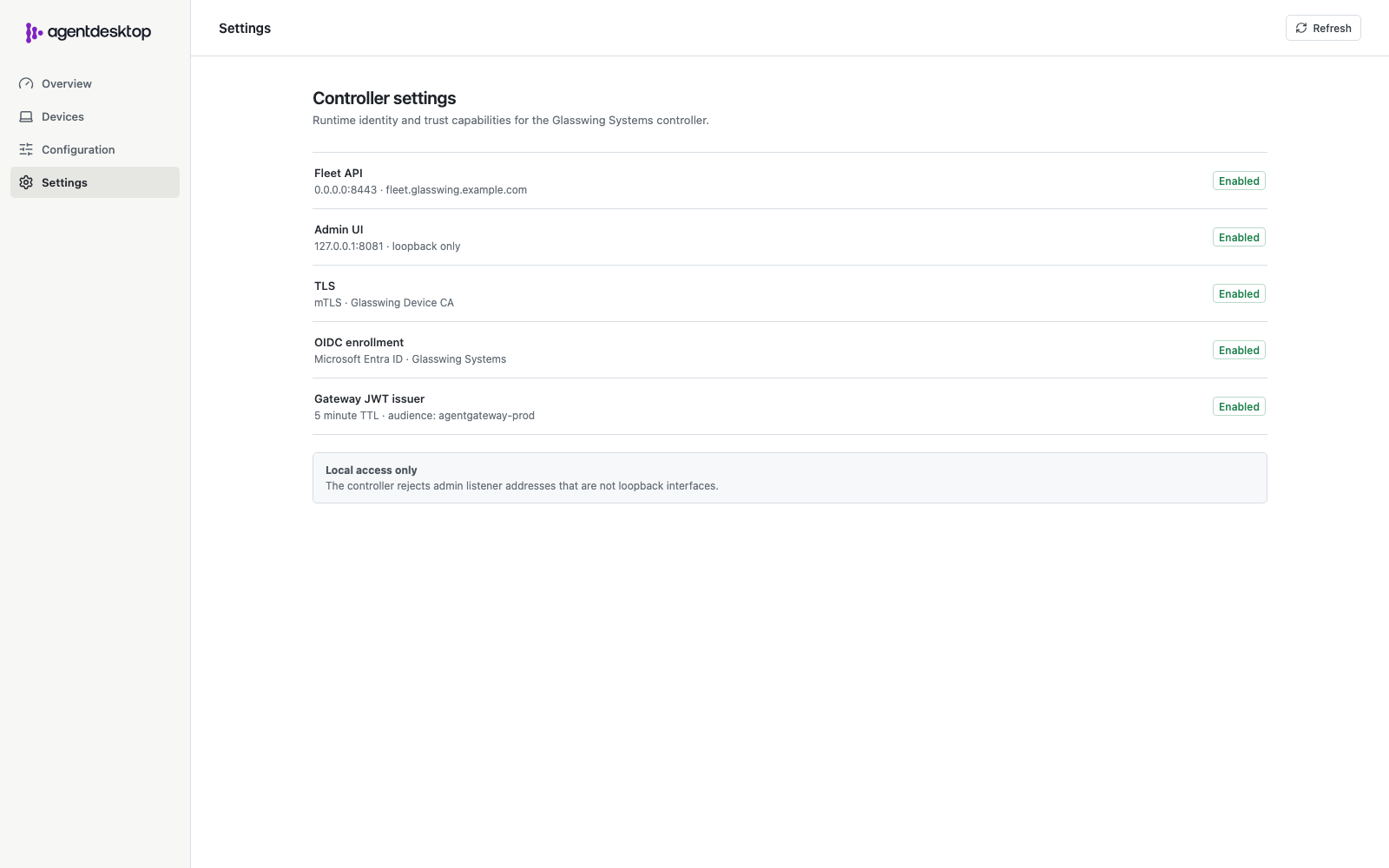
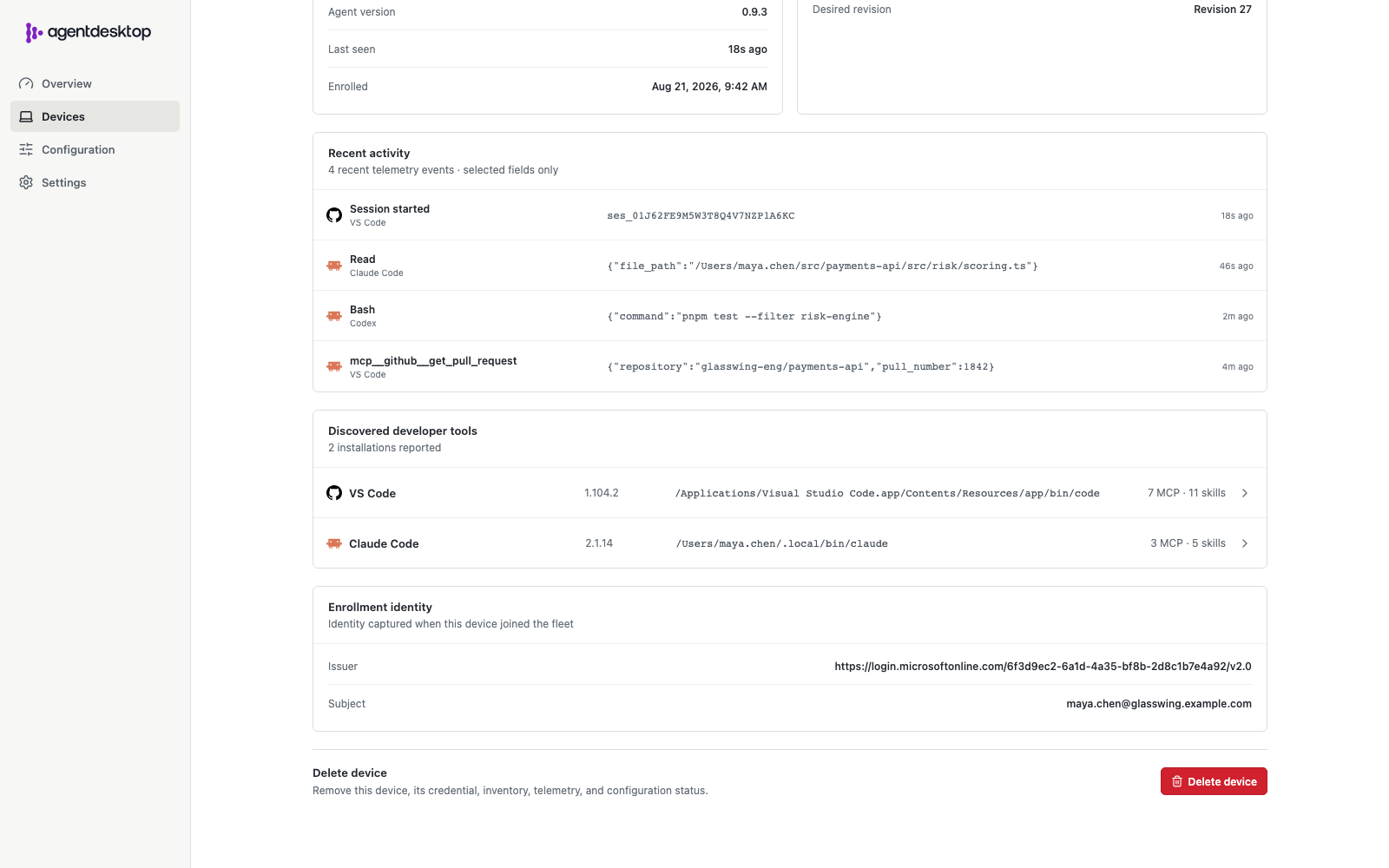
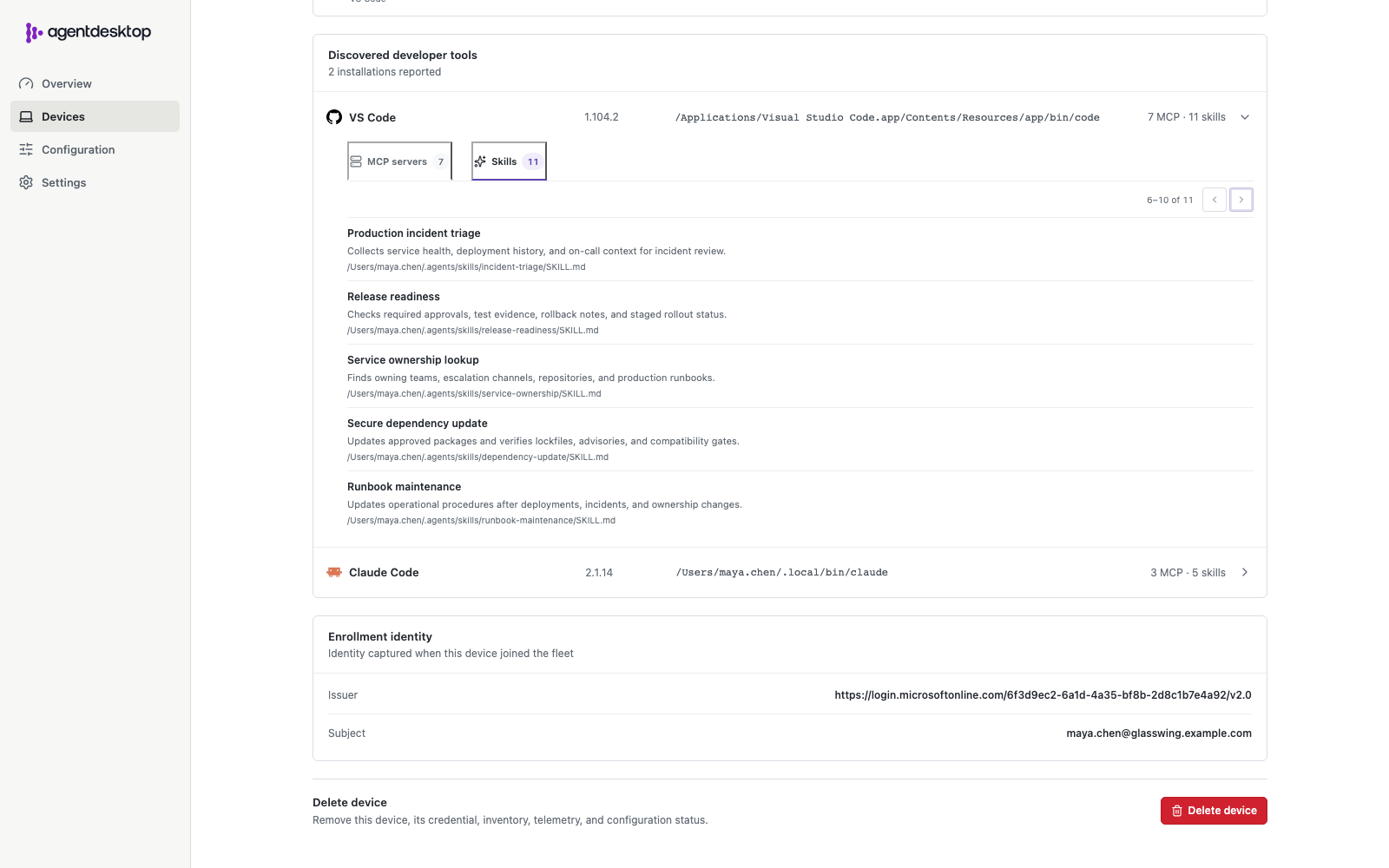
Agentdesktop device inventory showing discovered developer tools, MCP servers, skills, and local models

Device inventory

01 / 04
Discovery

Know what’s running.

Build the agent inventory security frameworks now call for: every harness, version, MCP server, and skill across the fleet, attributed to a device and its signed-in user. Surface shadow AI without reading secrets — no command arguments, environment variables, headers, or skill bodies.

How agentdesktop works

A daemon on each device, a controller for the fleet, and a trust chain to your inference gateway.

From device discovery to managed configuration and short-lived gateway identity. No developer-tool traffic passes through the controller.

One configuration, every tool.

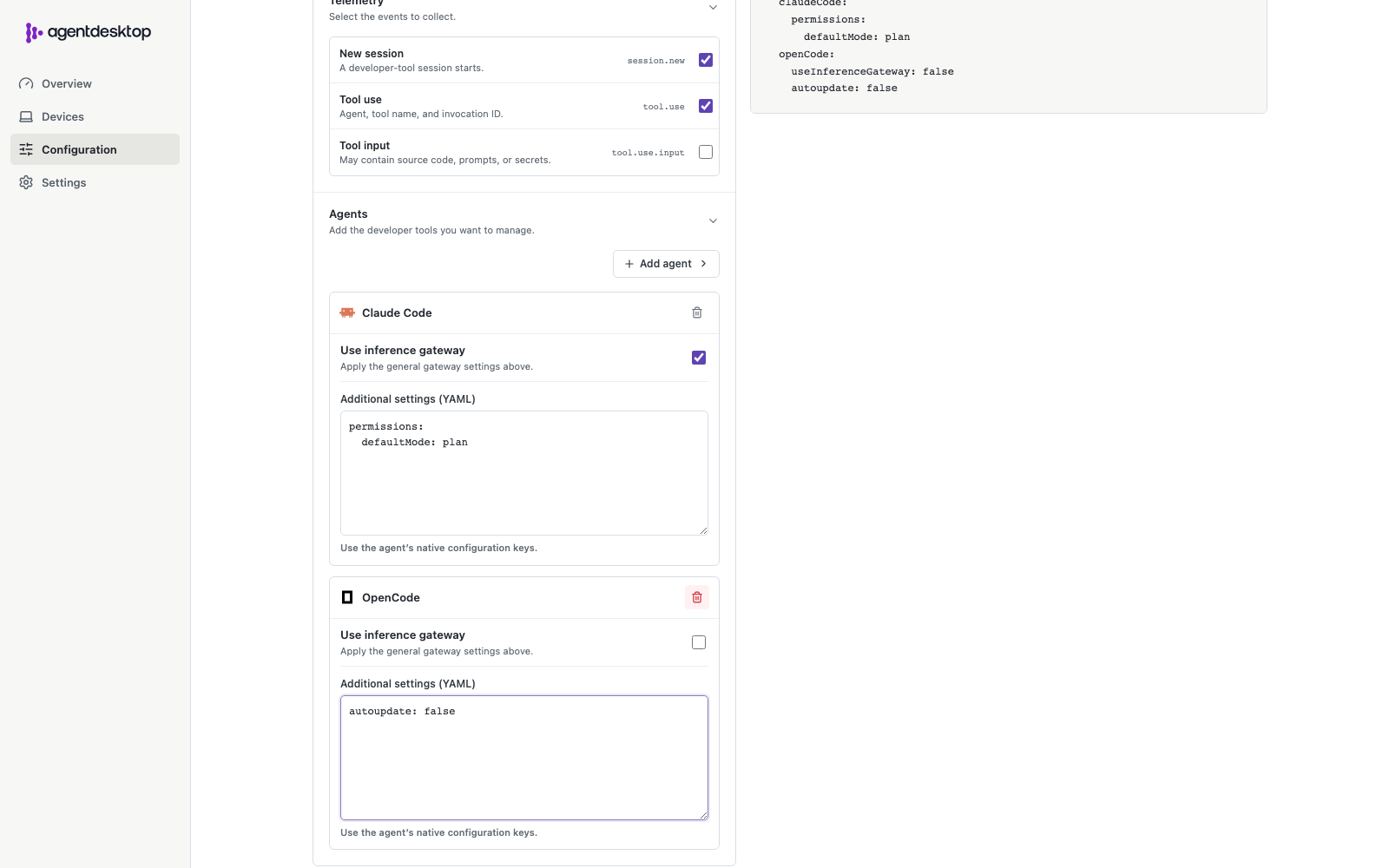
A single declarative config manages the gateway connection, telemetry, and per-tool policy — reconciled into Claude Code, Claude Desktop, Codex, and OpenCode in their own formats.

Pairs with agentgateway — or any inference gateway that verifies JWTs.

inferenceGateway:
  url: https://gateway.example.com
  authentication:
    type: controllerJwt
    audience: agentgateway

telemetry:
  events: [session.new, tool.use]

programs:
  claudeCode:
    permissions:
      defaultMode: plan
  claudeDesktop: {}
  codex: {}

Start with one device, extend to your entire fleet.

Standalone

Keep configuration local. Preview and apply changes from YAML without a controller or device identity, and authenticate directly to your gateway.

  • Local YAML configuration
  • Direct OIDC gateway auth
  • Dry-run before writing
Set up standalone mode

Controller-managed

Enroll devices and let the controller distribute versioned configuration. It also issues short-lived gateway JWTs and records fleet state for the management UI.

  • User + device enrollment
  • Versioned configuration
  • Opt-in session + tool events
Set up managed mode

Inspect the code and shape the roadmap.

100% open source, end to end. Browse the source, open an issue, or contribute.
View on GitHub